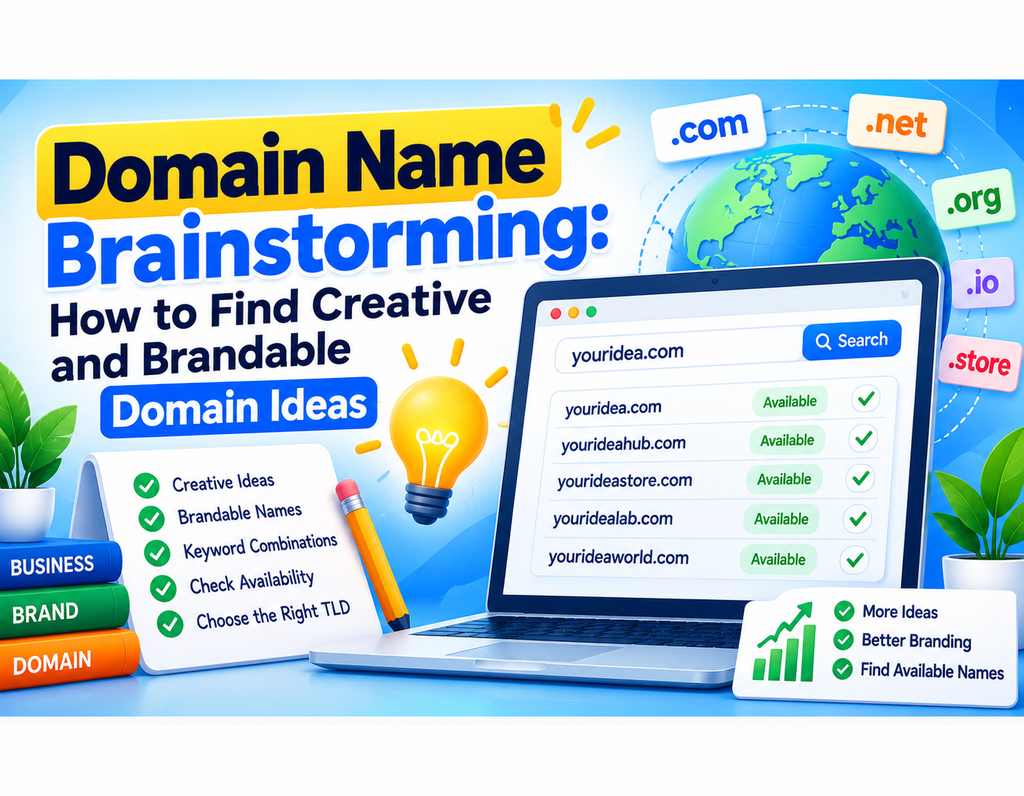
Domain name brainstorming can be surprisingly challenging when you need a name that is memorable, relevant, and available. You may already have a great business idea, a clear niche, and plenty of words that describe your brand, but turning those words into strong domain name ideas is often easier said than done.
Instead of randomly testing names one after another, you can start with meaningful keywords, combine related words, and explore different variations to discover creative and brandable domain names. Whether you brainstorm manually or use a domain name generator to speed up the process, the goal is to create a shortlist of names that are easy to remember, simple to spell, and suitable for the brand you want to build.
What Is Domain Name Brainstorming?
Domain name brainstorming is the process of coming up with, comparing, and refining possible names for a website or online business. It is more than simply checking whether a random domain is available.
A strong name should be easy to remember, simple to type, relevant to your idea, and suitable for the brand you want to build. For example, if you are creating an outdoor travel website, you might start with words such as:
- trail
- explore
- wild
- journey
- peak
- adventure
You can then combine these with business-related words such as:
- guide
- trips
- travel
- gear
- tours
This gives you many possible directions instead of forcing yourself to invent one name from nothing.
Start With Words That Describe Your Brand
Before searching for domain name ideas, take a few minutes to define what your project is actually about with Domain name brainstorming.
Think about your:
- business category
- products or services
- target customers
- location
- main topic
- brand personality
- unique selling point
At this stage, do not worry about whether a word sounds perfect. For a fitness website, for example, your first list could include:
Fitness words:
fit, active, strong, health, move
Brand words:
hub, lab, zone, coach, life
Combining words tool give you a starting point for creating different possible combinations. The purpose of domain name brainstorming is not to find the final name immediately. It is to create enough possibilities that you can later identify the strongest ones.
Generate a Large Pool of Ideas with Domain Name Brainstorming
Many people make the mistake of stopping after finding two or three names they like. That can become a problem when those names are already registered, difficult to spell, or too similar to another business. Instead, create a larger collection of brandable domain names before making your final decision.
For example, a fitness project might produce ideas such as:
- FitLab
- MoveLife
- ActiveHub
- FitZone
- StrongLife
- HealthLab
- MoveCoach
Not every result needs to be good.
Some names will sound awkward or completely unsuitable. That is normal. Brainstorming works better when you separate idea generation from idea selection. A wider list gives you more room to compare names objectively.
Combine Different Word Groups
Manually testing every possible combination becomes difficult when your word lists start getting larger. Imagine having 15 words describing your niche and another 15 words describing your brand concept. Checking every possible pairing manually would quickly become repetitive. This is where a keyword combination tool can make the process more efficient.
With MergeKeywords.com, you can enter separate groups of words and generate combinations without typing each one individually. For example:
List 1
green
eco
pure
earth
List 2
living
home
market
shop
The resulting combinations might include:
green living
green home
green market
green shop
eco living
eco home
eco market
eco shop
pure living
pure home
These are not automatically finished domain names. They are raw ideas that you can refine.
Remove spaces, test different extensions, change the word order, or modify individual words until you find combinations that feel natural.
Think Beyond Exact Keywords using Domain Name Brainstorming
Including your main keyword in a domain can sometimes make the purpose of a website obvious, but it is not the only approach. A memorable brand name does not necessarily need to describe everything the business does.
For example, a company may choose a short, distinctive name and build its meaning around the brand over time. When doing domain name brainstorming, therefore, experiment with both descriptive combinations and more creative concepts.
Try combining:
- industry + action
- product + benefit
- adjective + niche
- location + service
- concept + audience
- descriptive word + brand word
This can produce more interesting creative domain names than simply joining two obvious keywords.
Keep the Name Simple
A domain name should be easy for another person to remember and type.
Ask yourself a few simple questions:
- Can someone remember it after hearing it once?
- Is the spelling obvious?
- Does it sound natural when spoken?
- Is it easy to type on a phone?
- Could someone confuse it with another word?
Long names can sometimes work, but unnecessary complexity makes them harder to communicate. Avoid adding extra words simply because you cannot find an available short option. A clean, memorable name often gives a business more flexibility as it grows.
Be Careful With Hyphens and Numbers
Hyphens and numbers are not automatically bad, but they can introduce unnecessary confusion. Imagine telling someone your website address over a phone call.
If the name contains several numbers, unusual spellings, or multiple hyphens, you may have to explain exactly how it is written. During domain name brainstorming, test each candidate verbally. Say it naturally and imagine someone hearing it without seeing it on a screen.
If you immediately need to explain the spelling, put that name lower on your shortlist. The goal is not simply to find an available domain. It is to find a name that people can use without repeatedly asking how to spell it.
Explore Different Domain Extensions by Domain name brainstorming
The extension is another part of the naming process. The familiar .com remains widely used, but today’s domain ecosystem includes many generic and country-code extensions. Depending on your audience and project, alternatives such as .net, .org, .co, .io, .shop, and .online may also be relevant.
A suitable extension can complement your brand, but do not choose one just because it looks different. Consider where your audience is located and what your website does. For a country-focused business, a country-code domain may make sense. For a technology project, a technology-oriented extension might fit the brand.
Check Domain Availability
Once you have a shortlist, the next step is checking whether your preferred names are available. A name generated during domain name brainstorming is only an idea until you confirm its availability through a domain registrar.
Do not become too attached to your first choice. Someone else may already own it, or the domain may be listed for sale at a price that does not fit your budget.
If your preferred name is unavailable, try changing the word order, replacing one word with a synonym, shortening the phrase, or testing another relevant extension. Always treat generated names as starting points rather than guaranteed available domains.
Check Existing Brands and Trademarks
A domain being available does not automatically mean that the name is safe to use as a business brand. Before committing to an important name, search for businesses and trademarks using Domain name brainstorming. For example, if you discover that another company already operates under a very similar name in your industry, choosing a different option may help avoid confusion.
Trademark databases can be useful during this stage and USPTO provides a searchable trademark database for checking existing marks in the United States. If your business will operate commercially across multiple markets, consider checking the relevant trademark databases for those markets as well.
Avoid Names That Limit Future Growth
Your current business idea may not be your business five years from now and a domain that is extremely specific to one product can become restrictive if you later expand into related products or services.
For example, a business selling only one type of fitness product might eventually expand into training programs, accessories, nutrition, or other categories.
During domain name brainstorming, ask yourself whether the name would still make sense if the business grows. A flexible brand can save you from having to change your domain later.
Create a Shortlist for Domain name brainstorming
After generating a large collection of ideas, do not immediately register the first available domain. Create a shortlist of perhaps 10 to 20 candidates. Then compare each name based on:
- memorability
- pronunciation
- spelling
- relevance
- brand potential
- simplicity
- extension
- availability
- possible brand conflicts
A name that initially looks impressive may become less attractive when compared with several alternatives. The strongest domain name ideas usually become easier to recognize after you have removed the weaker options which is only done through Domain name brainstorming.
Use MergeKeywords to Speed Up the Process
Generating combinations manually can take a considerable amount of time when you are working with many keywords. MergeKeywords.com allows you to combine separate word lists quickly, making it easier to explore different naming directions.
For example, you could create one list containing industry terms and another containing brand concepts. You could also combine:
- locations + services
- products + benefits
- niches + descriptive words
- industries + brand terms
- adjectives + business concepts
Instead of manually creating every combination, the tool handles the repetitive part. You can then take the generated results and focus on the important part for deciding which names are memorable, relevant, available, and suitable for your brand.
Final Thoughts for Domain Name Brainstorming
A structured domain name brainstorming process gives you more possibilities while making the final selection easier. Once you have a shortlist, check availability, review relevant domain extensions, look for potential brand or trademark conflicts, and test each name for spelling and memorability.
If you are working with large keyword groups, MergeKeywords.com can handle the repetitive combination work and help you generate a much broader set of naming possibilities. The tool can give you more combinations to explore.